AWS Discover
Connector dependencies
The following monitoring connectors will be installed when you install the AWS Discover connector through the Configuration > Connectors > Monitoring Connectors menu:
- Base Pack
- Amazon API Gateway
- Amazon Backup Vault
- Amazon EBS
- Amazon EC2
- Amazon EFS
- Amazon FSx
- Amazon Kinesis
- AWS Lamba
- Amazon RDS
- Amazon S3
- Amazon SNS
- Amazon SQS
- AWS VPN
Pack assets
The AWS Discover monitoring connector does not offer a host template directly, it is based on the packs listed above.
Host discovery
| Rule name | Description |
|---|---|
| Amazon AWS API Gateway | Discover Amazon AWS API Gateway instances |
| Amazon Web Service Backup Vault | Discover AWS Backup Vault host |
| Amazon AWS EBS | Discover Amazon AWS Elastic Block Store host |
| Amazon AWS EC2 | Discover Amazon AWS EC2 instance |
| Amazon AWS ASG | Discover Amazon AWS Auto Scaling Groups |
| Amazon AWS EFS | Discover Amazon AWS EFS instances |
| Amazon AWS FSX | Discover Amazon AWS FSX intances |
| Amazon AWS Kinesis | Discover Amazon AWS Kinesis streams hosts |
| Amazon Web Service Lambda | Discover AWS Lambda instances |
| Amazon AWS RDS | Discover Amazon AWS RDS instances |
| Amazon AWS S3 | Discover Amazon AWS S3 instances |
| Amazon Web Service SNS | Discover AWS SNS Topics |
| Amazon Web Service SQS | Discover AWS SQS queues |
| Amazon AWS VPN | Discover AWS VPN |
More information about discovering hosts automatically is available on the dedicated page.
Collected metrics & status
No metrics or status for this monitoring connector.
Prerequisites
AWS Privileges
Configure a service account (access/secret key combo). The following rights have to be granted to the IAM role (accesskey/secretkey or AssumeRole):
| AWS Privilege |
|---|
| apigateway:GetRestApis |
| backup:ListBackupVaults |
| ec2:DescribeVolumes |
| ec2:DescribeInstances |
| ec2:DescribeSpotFleetRequests |
| ec2:DescribeVpnConnections |
| efs:DescribeFileSystems |
| elb:DescribeLoadBalancers |
| elbv2:DdescribeLoadBalancers |
| fsx:DescribeFileSystems |
| kinesis:ListStreams |
| lambda:ListFunctions |
| rds:DescribeDBInstances |
| s3api:ListBuckets |
| sns:ListTopics |
| sqs:ListQueues |
| cloudwatch:listMetrics |
| cloudwatch:getMetricStatistics |
Plugin dependencies
To interact with the Amazon APIs, you can use either use the awscli binary provided by Amazon or paws, a Perl AWS SDK (recommended). You must install it on every poller expected to monitor AWS resources.
Please note that you cannot use paws if you are connecting via a proxy.
- perl-Paws-installation
- aws-cli-installation
yum install perl-Paws
curl "https://awscli.amazonaws.com/awscli-exe-linux-x86_64.zip" -o "awscliv2.zip"
unzip awscliv2.zip
sudo ./aws/install
Installing the monitoring connector
Pack
The installation procedures for monitoring connectors are slightly different depending on whether your license is offline or online.
- If the platform uses an online license, you can skip the package installation instruction below as it is not required to have the connector displayed within the Configuration > Connectors > Monitoring Connectors menu. If the platform uses an offline license, install the package on the central server with the command corresponding to the operating system's package manager:
- Alma / RHEL / Oracle Linux 8
- Alma / RHEL / Oracle Linux 9
- Debian 11 & 12
- CentOS 7
dnf install ccentreon-pack-cloud-aws\*
dnf install centreon-pack-cloud-aws\*
apt install centreon-pack-cloud-aws\*
yum install centreon-pack-cloud-aws\*
- Whatever the license type (online or offline), install the Amazon API Gateway connector through the Configuration > Connectors > Monitoring Connectors menu.
Plugin
Since Centreon 22.04, you can benefit from the 'Automatic plugin installation' feature. When this feature is enabled, you can skip the installation part below.
You still have to manually install the plugin on the poller(s) when:
- Automatic plugin installation is turned off
- You want to run a discovery job from a poller that doesn't monitor any resource of this kind yet
More information in the Installing the plugin section.
Use the commands below according to your operating system's package manager:
- Alma / RHEL / Oracle Linux 8
- Alma / RHEL / Oracle Linux 9
- Debian 11 & 12
- CentOS 7
dnf install centreon-plugin-Cloud-Aws-Cloudwatch-Api
dnf install centreon-plugin-Cloud-Aws-Cloudwatch-Api
apt install centreon-plugin-cloud-aws-cloudwatch-api
yum install centreon-plugin-Cloud-Aws-Cloudwatch-Api
Access parameters
Create a new discovery job and select AWS Discover as the provider. Click on next and set the authentication parameters as well as optional access parameters if needed:
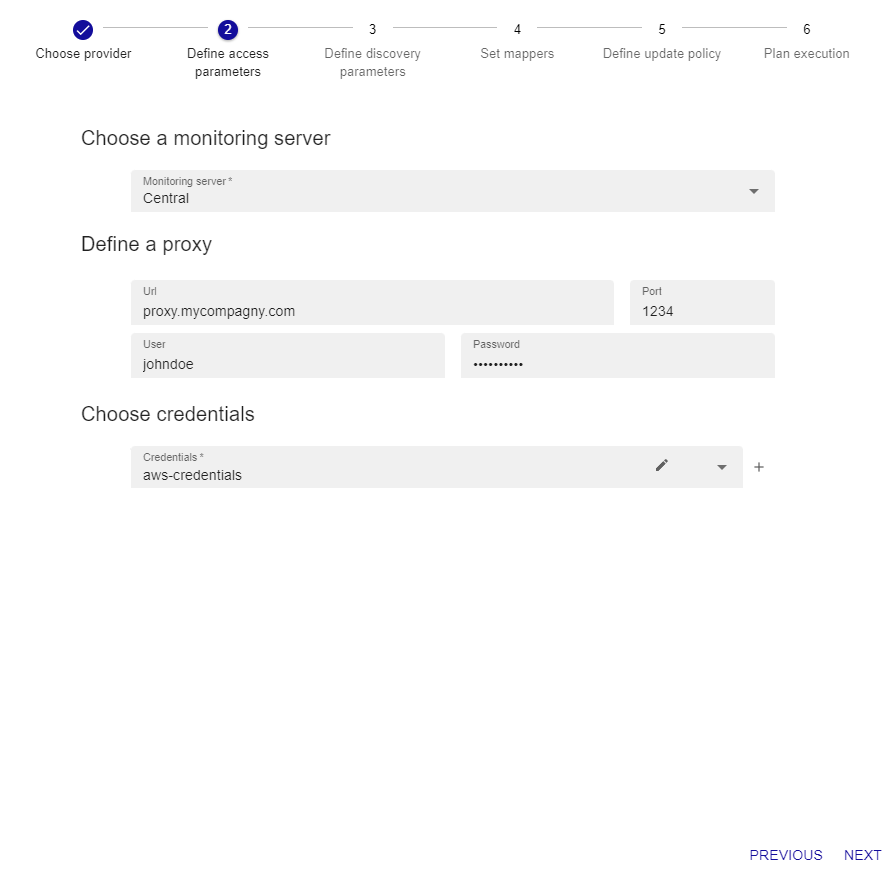
- Select the Centreon Poller from where the discovery job will be launched
- If necessary, add an entreprise proxy URL and port to use to reach the AWS API
- If necessary, select the AWS credentials profile linked to the subscription to be used
A new credentials profile has to be created the first time you need to use this authentification method. You can do so by clicking the '+' button and set the proper AWS authentication parameters:

Click on confirm then next to go to the next step of the wizard and adjust the discovery parameters.
Discovery parameters
Adjust the following settings:
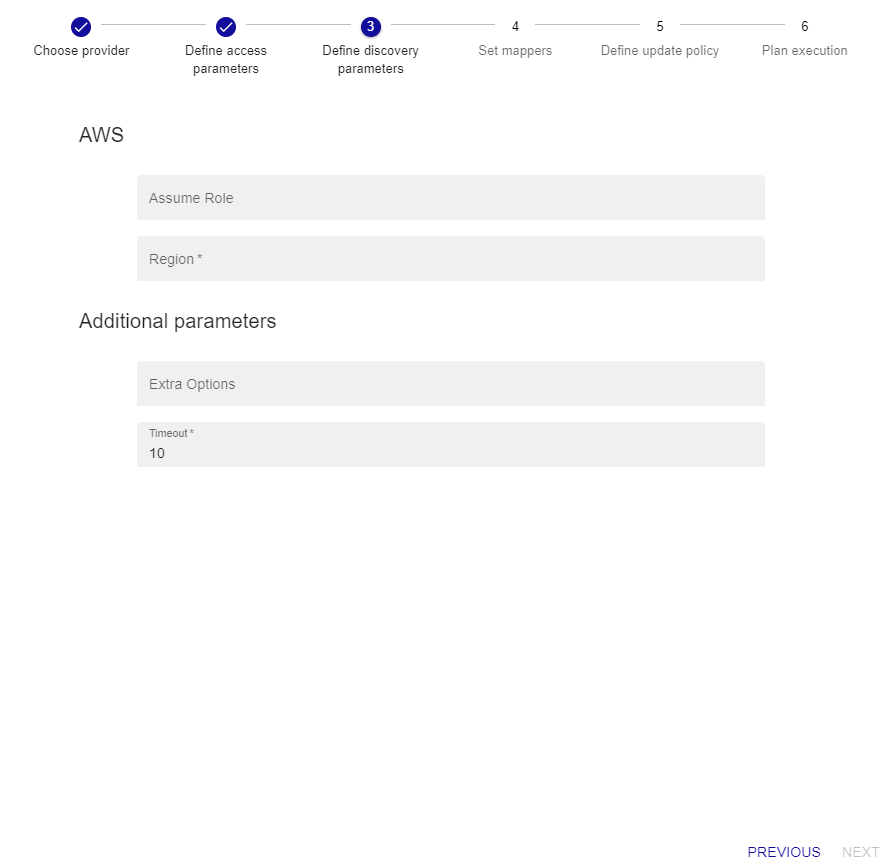
All the fields of this form are optional.
- AWS Region : Set the region name
- AWS Assume Role : Set arn of the role to be assumed if you are not using an AWS credentials profile
Run the discovery job and display results
The step 4 of the wizard allows to adjust and set mappers if necessary; the Monitoring Connector comes along with predefined mappers that don't typically need to be changed. If you have a specific need and want to edit the mappers section, refer to this documentation to do so.
Final steps 5 & 6 will allow you to define a specific policy about the data modeling of the discovered results. Although the default configuration is usually enough to proceed, this documentation will help you to customize it if needed. Coming to step 6, just click on finish to launch the discovery job.
Once the discovery job complete, you can display the results by clicking on job results. All the available Host Templates corresponding to the discovered AWS resources will be automatically set, like in the example below:
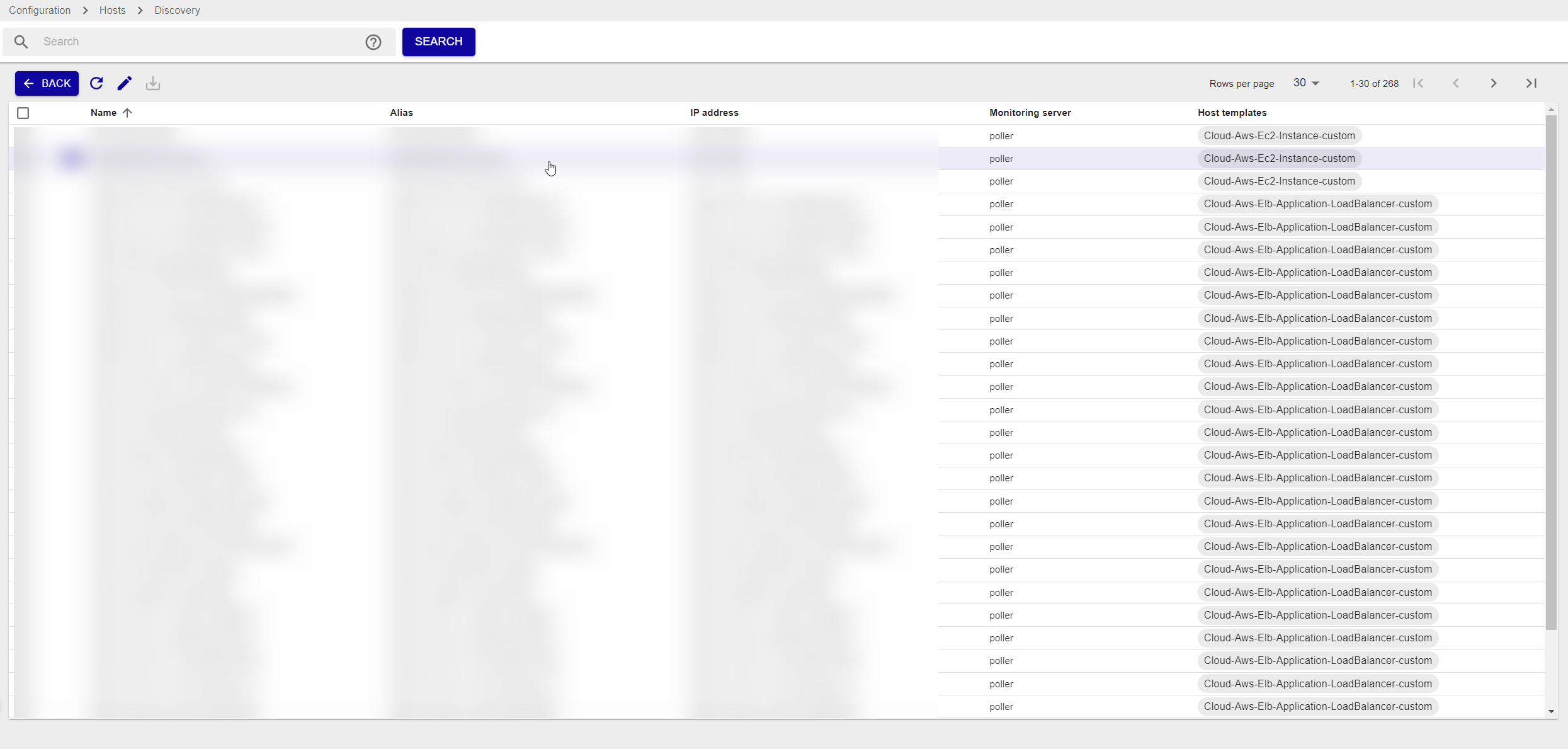
Some discovered elements may come up without any predefined Host Template; this is usually due to one or several mappers conditions that cannot be applied.
Just select the elements you want to add to the Centreon configuration and click on save. And... you're done !
Troubleshooting
Please find the troubleshooting documentation for Centreon Plugins typical issues.